


80 Years Together
Cargo has been fundamental to the Cathay Group’s journey since day one, 80 years ago, and its importance has only grown over time

80 years with Cathay Cargo
When our founders started operations in Hong Kong in 1946 with Betsy, a converted ex-military DC3, they could only have dreamt of becoming a leading combination cargo carrier with a global passenger network served by more than 200 aircraft and 20 dedicated freighters, all based at the world’s number-one cargo airport.
Explore our incredible journey as we grew alongside our home hub with inspiring stories that shaped our present from our past. Check back for new stories each month.

Fleet and network: highlights of our first 80 years
From 1946 to 2026, a look at some of the landmark dates in our history related to the aircraft we’ve flown and the destinations we fly to

Fleet and network: by the numbers
A further look at the some of the aircraft and destination launches that have helped create today’s Cathay Cargo
Technology and innovation
For the past 80 years, Cathay Cargo has pioneered technology to innovate in the air cargo industry.
80 years of packaging innovation
.jpg/_jcr_content/renditions/cq5dam.rendition.450.300.jpg)
As light as air in 1973
Customers pay for weight and volume in air cargo, so anything that saves either is welcome. A piece in Cargo Clan magazine extolled the virtues of new-to-market bubble wrap. “Any product is better and more economically protected by air,” said the piece. It also proved that using bubble wrap over “voluminous” crumpled paper saved more than 18 per cent in volume.
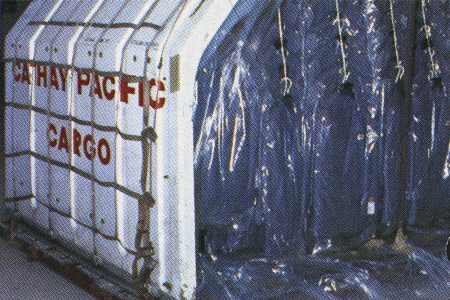
Getting the hang of garments in 1979
At the height of Hong Kong’s garment boom, air-freighted suits were carried in cardboard boxes with hangers, which didn’t hold many nor offer great protection, but added volume and cost. Cathay Pacific, clothing brand D’urban, and forwarder Air Express International put their heads together and came up with a cheap solution that added a bar and hanging hooks to a standard plastic “igloo” pallet cover that enabled up to 1,000 garments to be hung. The bar could be removed for the return flight to carry different cargo.
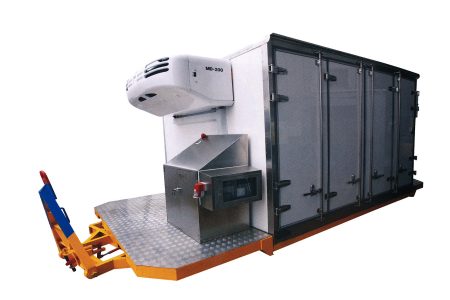
Keeping pharma transfers cool in 2010
Pharma shipments by air have always been dependent on some form of temperature control, tricky during ramp transfers. Cathay Pacific Cargo developed the thermal dolly, a movable refrigerated storage device to transfer shipments between aircraft and the terminal. Today, they can be hired for temperature-sensitive shipments when booking.
.jpg/jcr:content/renditions/cq5dam.rendition.900.600.jpg)


80 years of packaging innovation
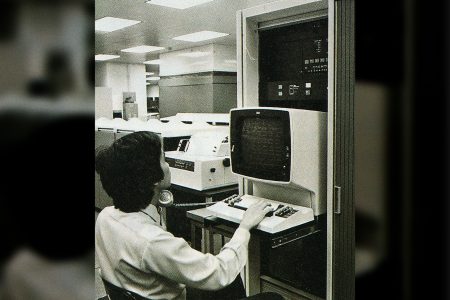
Computing power for the people in 1983
Cathay Pacific became the proud owner of “Asia’s most complex and powerful computer” to process everything from reservations to flight planning. The HK$28m IBM 3081 computer was the most powerful installed in Hong Kong since 1970 and required a minimum of 185sqm of air-conditioned space to house its water-cooled brain, which could handle 10 million instructions a second.

Customer access to bookings in the 1980s
There has long been a desire to put booking into agents’ hands. When CUBIC was debuted in 1983 (see above) the plan was to expand beyond Cathay’s 250 in-house terminals and let agents take control, including those outside Hong Kong. In 1984, CUBIC was in place in Japan (above) and by the end of 1986, more than 30 agents in Hong Kong had their own terminal enabling them to book and print their own air waybills.
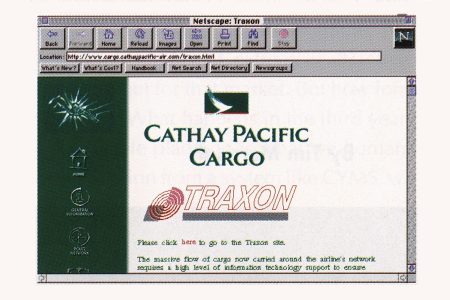
Getting the market on TRAXON
The modern idea of opening bookings to customers across platforms began with TRAXON in the early 1990s. It grew out of the Global Logistics System (now a technology partner of Cathay Cargo), which was then an airline-led booking platform. TRAXON addressed agents’ desire for “information through a single source, unbiased schedules and access to rates”. By 1995, more than 1,600 agents at more than 3,600 locations were online and could get a response for a booking enquiry in seven seconds.


80 years of shipment solutions
.jpg/_jcr_content/renditions/cq5dam.rendition.450.300.jpg)
An overnight success in the 1980s
The introduction of Cathay Pacific’s Boeing 747 passenger services to Europe, most of which were overnight, unearthed the opportunity to become a wholesale express courier with a scheduled overnight service for other courier firms. Cathay secured the services of Linehaul Express (Linex) as general sales agent, an arrangement that remains in place, underpinning the Cathay Courier solution.
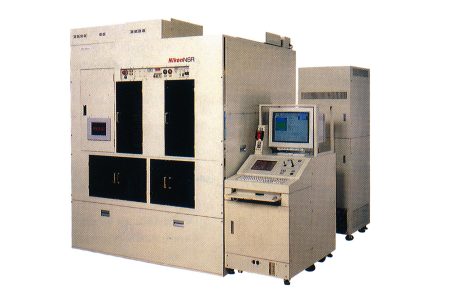
Stepper back in time for internet 1.0 in 1996
In 1996, the first browsers and commercial websites were appearing, fuelling a demand for computers, microprocessors and the machines that print them: steppers. These machines are bulky, but highly sensitive with dedicated shipment protocols including temperature, stability and timing. They remain a stalwart of the Cathay Expert solution today and a regular feature of shipments supporting the AI boom.

A LIFT for pharma shipments in 2008
It was estimated that temperature-sensitive pharmaceuticals market was worth US$130bn in 2008, so to protect these valuable shipments, Cathay Cargo introduced Pharma LIFT (now Cathay Pharma), which also offered priority handling, multiple checkpoints throughout the journey and greater shipment transparency. By 2010, Cathay Pacific Cargo was the only carrier to offer online temperature tracking for all active container pharma shipments.
.jpg/jcr:content/renditions/cq5dam.rendition.900.600.jpg)


80 years of customer booking
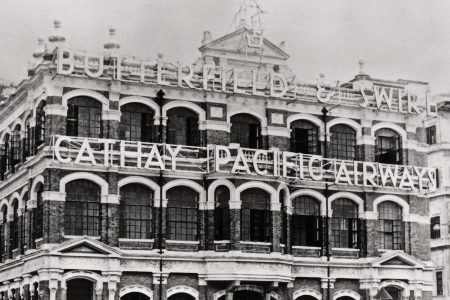
Then: Popping to the Peninsula
In the early days of the Hong Kong business, cargo customers would have either gone to HQ at 1 Connaught Road (pictured) – or perhaps popped into the ticket office at the Peninsula Hotel. It might have been hard to track down the airline’s founders by phone: as they were busy flying the company’s DC3s around Asia.
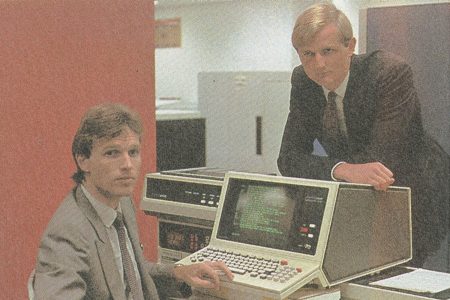
Next: From typewriters to TV screens
The 70s were powered by the pioneering COSAC air cargo computer system, run on a room-sized IBM 370 mainframe computer. A decade later we moved bookings to the CUBIC system, which saw teams swap typewriters and teleprinters for TV screens. Today, the DNA of that system remains in Cathay Cargo’s Cargo Spot operations platform.

Now: The advent of 24/7 booking
2021 saw the launch of Click & Ship, Cathay Cargo’s intuitive booking platform – and now, 80 per cent of bookings are made online.
Available at all hours, Click & Ship allows customers to make shipment bookings – and new in 2026, directly modify them in a few simple steps using the new Manage Booking functionality.


80 years of cargo loading
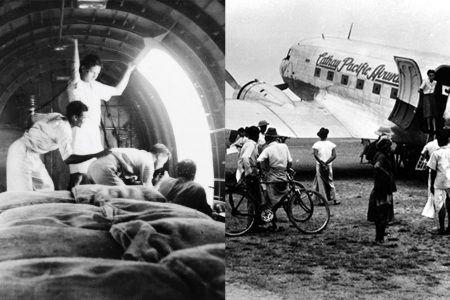
Then: Old-fashioned loading
In the early days of Cathay Pacific Airways, loading cargo on the airline’s DC3s was very basic: weight and balance calculations depended on the pilots’ knowledge and experience.
Occasionally, in the event of a technical issue or very bad weather, it was necessary for the flight crew to jettison cargo in flight.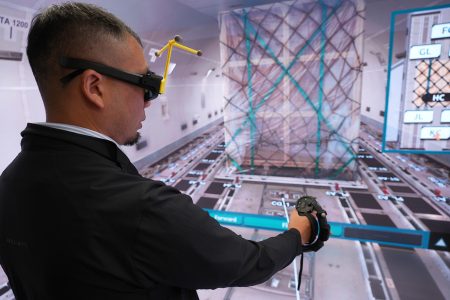
Next: Virtual training
Previously cargo loading theory was taught by demonstrating on cardboard model. In 2025 the Cathay Academy and Cathay Cargo combined to create the VR CAVE (Virtual Reality Cave Automatic Virtual Environment), which enables teams to learn how to strap down shipments a virtual environment – without occupying valuable aircraft downtime.
Now: Digital loading
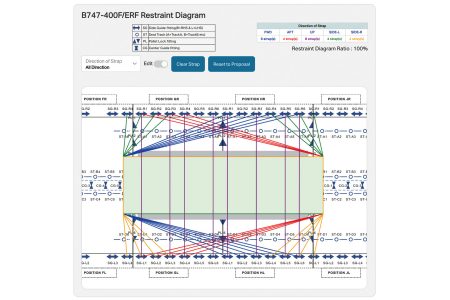
Cathay Cargo introduced HeavyPro in 2025: a digital form that takes approvals for out-of-gauge shipments from nine hours to three, 24/7.
The solution also calculates the strapping positions, which is sent to ramp staff’s Cargo Connect app, launched in 2023, enabling them to secure the shipment – paper-free.


80 years of online innovation
Then: The site that’s older than Google
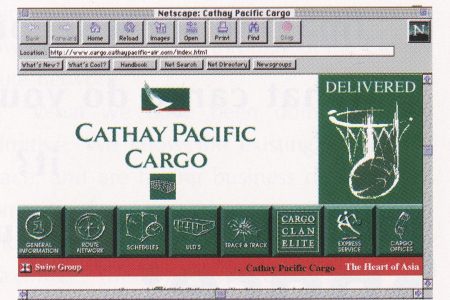
Cathay Cargo took a giant leap into cyberspace by launching its first website in 1996 – two years before the arrival of Google. Simple navigation buttons allowed users to check routes, schedules and to rudimentary TRAXON tracking. The Cargo Clan newsletter urged “those who have seen the future” to bookmark the page.
Next: Going mobile
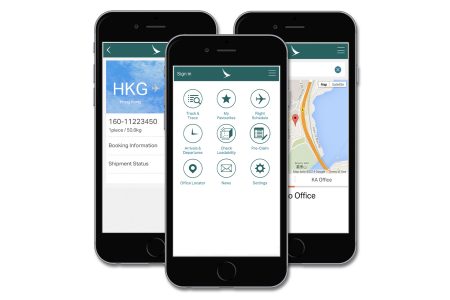
In 2015, as smartphones with bigger screens became standard, Cathay Cargo released its proprietary Cargo App. The app put limited but up-to-the-minute information at customers’ fingertips, as well as flight schedules, services and contact info.

Now: The online one-stop shop
As browsing and phone habits have changed, we’ve changed with the times.
cathaycargo.com is fully responsive for screens of all kinds, whether you’re checking a shipment in the office or booking a new on the go with your mobile. With our fully integrated Manage Booking feature, and you have a platform that’s fit for the age.


Our home hub
From our former home at Kai Tak Airport to our home today at Hong Kong International Airport (HKIA) at Chek Lap Kok and the wider Greater Bay Area (GBA), join us as we explore 80 years of our home hub – in numbers.
Our Early Days at Kai Tak

3,390 metres
The length of Runway 13/31 at Kai Tak Airport after its final extension into Victoria Harbour. In the late 1940s when Kai Tak opened to civil traffic with up to 25 aircraft movements a day, Cathay Pacific was at the heart of its operations, supercharging the airport and city’s development into a thriving hub of commerce and cargo.


Powering the world’s busiest cargo hub

No.1
HKIA’s status as the world’s busiest cargo hub, topping the list in 2025 for the 15th time since 2010. The year saw 5.07 million tonnes of total cargo throughput at the port – and Cathay Cargo was the largest contributor with 1.68 million tonnes. That’s more than 100,000 times greater than the 15 tons it carried in 1946, 80 years ago.


Gateway to and from the GBA

3 intermodal links in and out of the GBA
Air, land and sea all come together with Cathay Cargo in the GBA. Air-to-air links between Hong Kong and Guangzhou, air-land links via extensive trucking services and air-sea services to and from Cathay Cargo Terminal Dongguan, which opened in 2022 to allow seamless, end-to-end transfers easier than ever.

86 million people
The population we serve from HKIA, the aviation gateway for the GBA. The GBA is the Chinese Mainland’s manufacturing heartland, with world-leading e-commerce, consumer electronics and tech firms – and it is also an increasingly large import market. Cathay Cargo’s intermodal connectivity, as well as new options such as the Air-Land Fresh Lane from 2025, form the lynchpin of its success.

Solutions and shipments: the evolution of special handling
Handling Cargo with special requirements has always been a challenge willingly accepted. We look at past shipments that have helped shape our suite of specialist solutions

Solutions and shipments: record-breakers
A look at some the record-breaking flights, firsts and noteworthy shipments we’ve carried over 80 years that set the standard and broke records
Our people
People have always been the pulsing heart of Cathay Cargo, going the extra mile over 80 years to keep our promise to customers and shaping the company we have today. We catch up with some of our people, past and present, to see how they embraced change to keep pace with the dynamics of the ever-changing air cargo industry.
Leadership and the Hong Kong hub strength
Ron Mathison, former Director Cargo
Ron served as Director Cargo from 2004 to 2008, leading a period of major investment in new freighter capacity and the construction of the Cathay Cargo Terminal at Hong Kong International Airport.

Adapting to constant change
Michael Spiegel, Area Cargo Manager Northern Europe
Michael joined Cathay Cargo as an intern and has spent more than 26 years helping grow its presence in Europe.

Heavyweight Italian memories
Alberto Brandi, Regional Pricing and Performance Manager, Europe
Alberto joined Cathay Cargo in 2001 and has spent 24 years in roles across customer service and operations in Italy

Chinese Mainland memories
Jenny He, Area Head Eastern China, Cathay Pacific
Jenny worked for Cathay Cargo for six years from 2018 to 2024 and continue to be part of the Cathay family

Creating a digital future
Simon Ng, former Head of Cargo Distribution
Simon spent nearly eight years at Cathay Cargo working on multiple digitalisation projects, including digitalising rate sheets, implementing the automated booking platform and broadening our Cargo distribution channels through various marketplaces.

Delivering for customers
Dennis Basten, Area Cargo Manager & Country Lead – New Zealand (retired)
Dennis joined Cathay Cargo in 2010 after more than 30 years in freight forwarding and retired in this year

Bringing people together
Myra Lee, Assistant Manager Engagement Projects (retired)
Myra joined Cathay in 1989; moving to Cathay Cargo in 2005 and she retired in 2026

Follow



Privacy
Terms & Conditions
Cathay Subsidiaries
Follow
Cookies settings
