


80 Years Together
Cargo has been fundamental to the Cathay Group’s journey since day one, 80 years ago, and its importance has only grown over time

80 years with Cathay Cargo
When our founders started operations in Hong Kong in 1946 with Betsy, a converted ex-military DC3, they could only have dreamt of becoming a leading combination cargo carrier with a global passenger network served by more than 200 aircraft and 20 dedicated freighters, all based at the world’s number-one cargo airport.
Explore our incredible journey as we grew alongside our home hub with inspiring stories that shaped our present from our past. Check back for new stories each month.
Our fleet and network
Over the past 80 years, our dedication to cutting-edge aircraft and opening up new routes has shaped Cathay Cargo into a global combination carrier.

Humble beginnings
In 1946, Cathay Pacific’s founders Roy Farrell and Sydney de Kantzow registered their airline in Hong Kong, operating an ex-US Army DC-3, nicknamed Betsy. In its first year, Cathay Pacific Airways carried 15 tonnes of cargo. In 2025, Cathay Cargo carried more than 100,000 times that volume.

Intermodal links with Macao
Cathay Cargo’s intermodal links with the Greater Bay Area date back to 1947, when Cathay Pacific bought two Catalina seaplanes, in part to serve runway-less Macao on lucrative cargo-only bullion flights.
Our fleet and network
Over the past 80 years, our dedication to cutting-edge aircraft and opening up new routes has shaped Cathay Cargo into a global combination carrier.
Intermodal links with Macao
Cathay Cargo’s intermodal links with the Greater Bay Area date back to 1947, when Cathay Pacific bought two Catalina seaplanes, in part to serve runway-less Macao on lucrative cargo-only bullion flights.
Humble beginnings
In 1946, Cathay Pacific’s founders Roy Farrell and Sydney de Kantzow registered their airline in Hong Kong, operating an ex-US Army DC-3, nicknamed Betsy. In its first year, Cathay Pacific Airways carried 15 tonnes of cargo. In 2025, Cathay Cargo carried more than 100,000 times that volume.

Cathay joins the jet age
In the ’60s, Cathay Pacific reached an inflection point: join the jet age or get left in its wake. In 1962, it bought two Convair 880s. By 1968, the fleet was all-jet – putting Cathay Pacific at the forefront of aviation.

Going jumbo
Cathay Pacific was thinking big in 1979 when its first passenger Boeing 747 joined the fleet. The jumbo jet marked a turning point and ended its time as a regional consolidator for other long-haul carriers, by allowing it to serve long-haul cargo routes.

Our first dedicated freighter
Cargo has always played an important role for Cathay Pacific’s business, but its significance was writ large in 1976 – on the side of a converted Boeing 707 freighter, which bore the words “Cathay Pacific Cargo” for the first time.

Discovering the Americas
1983 saw Cathay Pacific’s first flight to Vancouver, bringing to life the “Pacific” vision of the airline’s founders. To this day, the transpacific route continues to be Cathay Cargo’s busiest trunk route.
Our first dedicated freighter
Cargo has always played an important role for Cathay Pacific’s business, but its significance was writ large in 1976 – on the side of a converted Boeing 707 freighter, which bore the words “Cathay Pacific Cargo” for the first time.
Cathay joins the jet age
In the ’60s, Cathay Pacific reached an inflection point: join the jet age or get left in its wake. In 1962, it bought two Convair 880s. By 1968, the fleet was all-jet – putting Cathay Pacific at the forefront of aviation.
Discovering the Americas
1983 saw Cathay Pacific’s first flight to Vancouver, bringing to life the “Pacific” vision of the airline’s founders. To this day, the transpacific route continues to be Cathay Cargo’s busiest trunk route.
Going jumbo
Cathay Pacific was thinking big in 1979 when its first passenger Boeing 747 joined the fleet. The jumbo jet marked a turning point and ended its time as a regional consolidator for other long-haul carriers, by allowing it to serve long-haul cargo routes.

Cathay buys the 777 “mini-freighter”
Most of Cathay Cargo’s tonnage is carried in the belly holds of the passenger fleet, made easier by the capacious Boeing 777-300. Cathay was the launch customer for this “mini freighter” in 1998 – back then the longest aircraft in production.

A giant freighter order
Cathay Cargo took delivery of its first of 14 Boeing 747-8Fs (B-LJE) in 2011. The order brought new scale and efficiency to cargo operations, reinforcing the role of the 747 as the backbone of our cargo network.
A giant freighter order
Cathay Cargo took delivery of its first of 14 Boeing 747-8Fs (B-LJE) in 2011. The order brought new scale and efficiency to cargo operations, reinforcing the role of the 747 as the backbone of our cargo network.
Cathay buys the 777 “mini-freighter”
Most of Cathay Cargo’s tonnage is carried in the belly holds of the passenger fleet, made easier by the capacious Boeing 777-300. Cathay was the launch customer for this “mini freighter” in 1998 – back then the longest aircraft in production.

Flying into the future
Cathay Cargo has placed an order for six next-generation Airbus A350F freighters, with options for 20 more – set to offer significant economies, as well as the largest cargo door of any production aircraft.
Technology and innovation
For the past 80 years, Cathay Cargo has pioneered technology to innovate in the air cargo industry.
80 years of customer booking
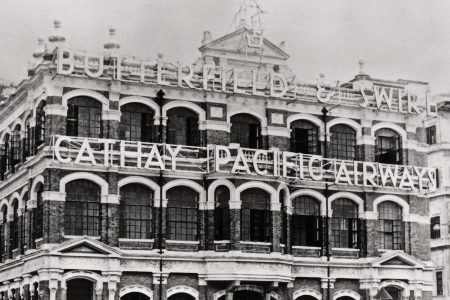
Then: Popping to the Peninsula
In the early days of the Hong Kong business, cargo customers would have either gone to HQ at 1 Connaught Road (pictured) – or perhaps popped into the ticket office at the Peninsula Hotel. It might have been hard to track down the airline’s founders by phone: as they were busy flying the company’s DC3s around Asia.

Next: From typewriters to TV screens
The 70s were powered by the pioneering COSAC air cargo computer system, run on a room-sized IBM 370 mainframe computer. A decade later we moved bookings to the CUBIC system, which saw teams swap typewriters and teleprinters for TV screens. Today, the DNA of that system remains in Cathay Cargo’s Cargo Spot operations platform.

Now: The advent of 24/7 booking
2021 saw the launch of Click & Ship, Cathay Cargo’s intuitive booking platform – and now, 80 per cent of bookings are made online.
Available at all hours, Click & Ship allows customers to make shipment bookings – and new in 2026, directly modify them in a few simple steps using the new Manage Booking functionality.


80 years of cargo loading
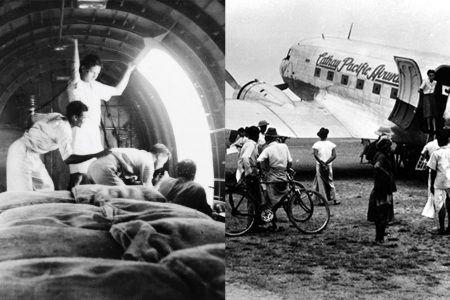
Then: Old-fashioned loading
In the early days of Cathay Pacific Airways, loading cargo on the airline’s DC3s was very basic: weight and balance calculations depended on the pilots’ knowledge and experience.
Occasionally, in the event of a technical issue or very bad weather, it was necessary for the flight crew to jettison cargo in flight.
Next: Virtual training
Previously cargo loading theory was taught by demonstrating on cardboard model. In 2025 the Cathay Academy and Cathay Cargo combined to create the VR CAVE (Virtual Reality Cave Automatic Virtual Environment), which enables teams to learn how to strap down shipments a virtual environment – without occupying valuable aircraft downtime.
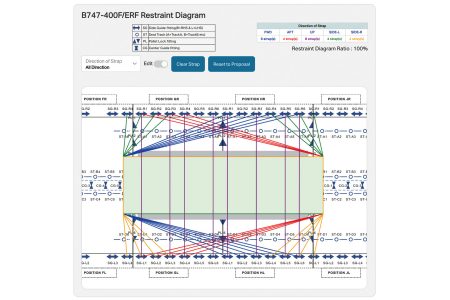
Now: Digital loading
Cathay Cargo introduced HeavyPro in 2025: a digital form that takes approvals for out-of-gauge shipments from nine hours to three, 24/7.
The solution also calculates the strapping positions, which is sent to ramp staff’s Cargo Connect app, launched in 2023, enabling them to secure the shipment – paper-free.


80 years of online innovation
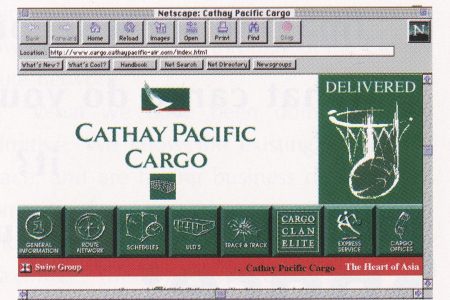
Then: The site that’s older than Google
Cathay Cargo took a giant leap into cyberspace by launching its first website in 1996 – two years before the arrival of Google. Simple navigation buttons allowed users to check routes, schedules and to rudimentary TRAXON tracking. The Cargo Clan newsletter urged “those who have seen the future” to bookmark the page.
Next: Going mobile
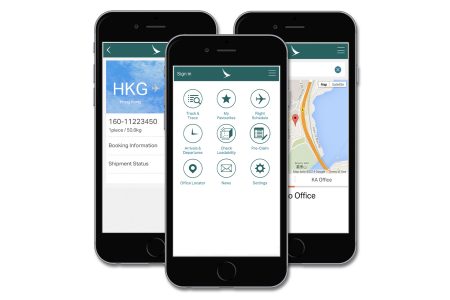
In 2015, as smartphones with bigger screens became standard, Cathay Cargo released its proprietary Cargo App. The app put limited but up-to-the-minute information at customers’ fingertips, as well as flight schedules, services and contact info.

Now: The online one-stop shop
As browsing and phone habits have changed, we’ve changed with the times.
cathaycargo.com is fully responsive for screens of all kinds, whether you’re checking a shipment in the office or booking a new on the go with your mobile. With our fully integrated Manage Booking feature, and you have a platform that’s fit for the age.


Our home hub
From our former home at Kai Tak Airport to our home today at Hong Kong International Airport (HKIA) at Chek Lap Kok and the wider Greater Bay Area (GBA), join us as we explore 80 years of our home hub – in numbers.
Our Early Days at Kai Tak

3,390 metres
The length of Runway 13/31 at Kai Tak Airport after its final extension into Victoria Harbour. In the late 1940s when Kai Tak opened to civil traffic with up to 25 aircraft movements a day, Cathay Pacific was at the heart of its operations, supercharging the airport and city’s development into a thriving hub of commerce and cargo.


Powering the world’s busiest cargo hub

No.1
HKIA’s status as the world’s busiest cargo hub, topping the list in 2025 for the 15th time since 2010. The year saw 5.07 million tonnes of total cargo throughput at the port – and Cathay Cargo was the largest contributor with 1.68 million tonnes. That’s more than 100,000 times greater than the 15 tons it carried in 1946, 80 years ago.


Gateway to and from the GBA

3 intermodal links in and out of the GBA
Air, land and sea all come together with Cathay Cargo in the GBA. Air-to-air links between Hong Kong and Guangzhou, air-land links via extensive trucking services and air-sea services to and from Cathay Cargo Terminal Dongguan, which opened in 2022 to allow seamless, end-to-end transfers easier than ever.

86 million people
The population we serve from HKIA, the aviation gateway for the GBA. The GBA is the Chinese Mainland’s manufacturing heartland, with world-leading e-commerce, consumer electronics and tech firms – and it is also an increasingly large import market. Cathay Cargo’s intermodal connectivity, as well as new options such as the Air-Land Fresh Lane from 2025, form the lynchpin of its success.
Solution and shipments
In our 80 years, we’ve never shied away from meeting challenging customer requests to test our cargo skills. Our zeal for customer service combined with air cargo’s growing capabilities, and the industry’s ever-more demanding requirements, led us to create a winning suite of shipment solutions. So now when it comes to shipping a world of possibilities – and we've had some memorable shipments – We Know How.

The world was and remains our oyster
Cathay Cargo’s expertise in handling perishables dates back to our founder, Roy Farrell, bringing oysters to Hong Kong on some of his earliest flights from Australia. The flight time back then was 32 hours, yet these were “brought alive in the shell from the Sydney Oyster Beds in the same time as they reach the Sydney householder,” the ad in the South China Morning Post exclaimed.
Back to today and our jet aircraft mean we are within five hours reach of 50 per cent of the world’s population, with the speed and cold-chain care of Cathay Fresh bringing perishable produce of all types and as nature intended to the world.
Bear necessity to optimal welfare
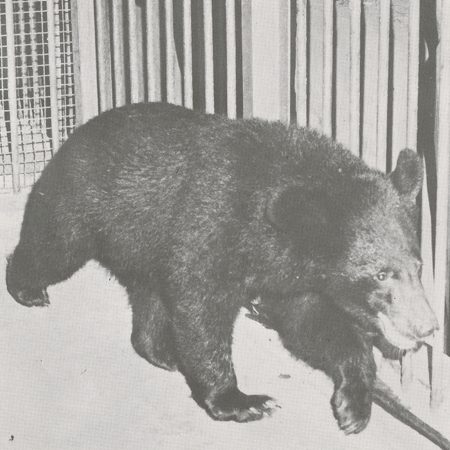
Cathay Cargo flew a bear for the first time in 1974. Bertha, as she became known, was found in a Mong Kok residential block stairwell and was eventually caught by the police. As there was no room at the zoo in the Hong Kong Botanical Gardens, Cathay Cargo offered to fly her for free to any interested zoo on the network. She was eventually flown to Taiwan. Since then, Cathay Cargo has flown many ursine passengers, not least the Ocean Park giant pandas gifted to Hong Kong in 2024, along with many other four-legged friends including the horses for the Hong Kong International Horse Show, all benefitting from the Cathay Live Animal solution that puts welfare very much first.

Diamonds are forever
Flying valuables has always relied on keeping things secure. The photograph from 1970 shows Cathay Ground Hostesses trying on jewellery and other valuables that could be placed in new secure boxes for travel, under the watchful eye of two security guards. These days, if you need currency, bullion or even priceless Egyptian artefacts moving, Cathay Secure offers strongrooms, surveillance, augmented by AI, to spot neglected cargo and suspicious loitering in the warehouse, as well as priority booking and uplift for valuables.


A trusted treatment transporter over time
Transport of pharmaceuticals has become an exacting business, as therapies and vaccines have become more complex, as have the demands of pharma logistics. It would not be possible now, as it was in 1969, to see a shipment of cholera vaccine on the ramp.
Today, vaccines and other therapies are generally transported in a cooltainer, which itself could be in a thermal dolly to limit the effects of ambient temperature before loading – all part of the Cathay Pharma service of dedicated and handling throughout.
Beaujolais Nouveau gets old over time
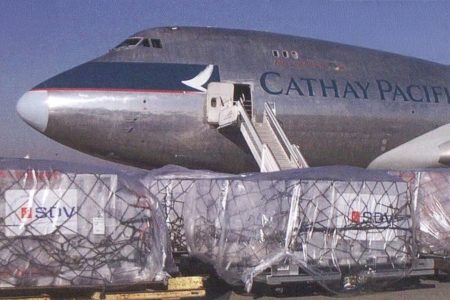
The annual Beaujolais Nouveau race was a wildly successful piece of marketing that brought kudos to a mediocre young wine from Burgundy – bottled and “ready to drink” in November each year. In 1982, the editor of The Sunday Times newspaper in London offered £10,000 to the first person to bring him a bottle after release day. The hype caught on in Asia, especially in Japan. In 1990, Cathay Cargo filled two 747 charters with 256 tonnes of wine for Tokyo. By 2004, Japan was importing 12 million bottles, but by 2021 total demand had fallen to 3.6 million as the allure faded. Today, Cathay Cargo still handles some Beaujolais Nouveau shipments, though most wine transported today is of a quality to justify the cost of airfreight.

Jurassic spark – and other heavyweights
Possibly one of the oldest and more unusual cargoes ever shipped arrived in Hong Kong from Kunming back in 2008. In four plain wooden crates were the bones of a prehistoric Lufengosaurus, an early-Jurassic-period dinosaur. A gift from Yunnan Province in the Chinese Mainland, the reassembled 180-million-year-old skeleton now resides in the Hong Kong Science Museum.
Today, the Cathay Expert solution ensures safe passage for priceless relics, such as the Terracotta Warriors , and other out of gauge or super-heavy shipments from jet engines to generators.


New solutions
While Cathay Cargo had long offered bespoke services for shipments requiring extra care, 2006 marked the launch of a branded range of products for special shipments . “The LIFT products aimed to raise awareness through more distinctive branding and segmentation ,” said a youthful Manager Cargo Sales & Marketing Ronald Lam. He has since progressed to be Chief Executive of the Cathay Group, while in 2022, the LIFT products were replaced by a refreshed range of Cathay Cargo special shipment solutions.

Fresh fruit, now all the time
John Antico of Antico International – an Australian produce company and a pioneer in air exports – spoke in Sydney in 1980 about the perils of the air-freight, while then exporting 2,000 tonnes of Australian fruit using waxed cardboard boxes. “The temperature here during summer can rise to over 100°F,” he said. “So the fruit comes in hot, is taken up to 35,000 feet, and then offloaded in a hot Asian or Middle East climate again, all of which makes it sweat. We have to watch out for these hazards.”
John recently celebrated his 50th year at Flemington market and still oversees exports that have grown exponentially in that time, and Antico still uses Cathay Cargo’s Cathay Fresh especially for seasonal exports of Tasmanian cherries to Asia.

Coming soon
More milestones and stories from our 80‑year journey will be unveiled over the coming months. Stay tuned.
Follow



Privacy
Terms & Conditions
Cathay Subsidiaries
Follow
Cookies settings
